

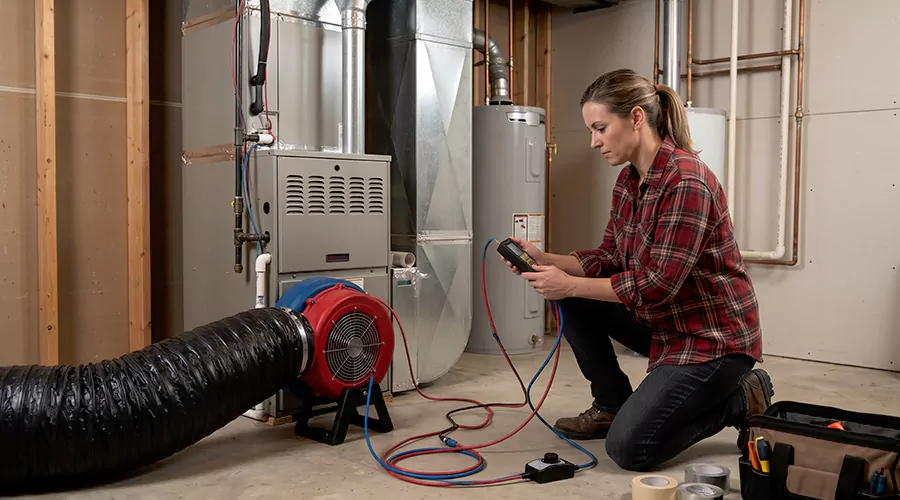
A Duct Blaster test is a professional diagnostic procedure that measures air leaking through the supply and return ducts of a heating and cooling system. The test uses a calibrated fan and a pressure gauge to determine how much air escapes through gaps, holes, and poorly sealed connections. It is commonly performed during new construction, energy audits, and duct sealing projects.
The Minneapolis Duct Blaster is a testing system manufactured by The Energy Conservatory. Other manufacturers produce similar duct-testing equipment, but the term Duct Blaster is widely associated with residential duct leakage testing. Professional air duct repair services can address leaks, damaged sections, and loose connections identified during duct inspections to help restore proper airflow.
Duct leakage is a common problem in homes with central HVAC systems. Conditioned air can escape into attics, crawlspaces, or other unintended areas before reaching living spaces. Return ducts may also draw unwanted air from these locations. A Duct Blaster test helps quantify this leakage instead of relying only on visual inspection.
What Does a Duct Blaster Test Measure?
The test measures the airtightness of the connected HVAC duct network. During testing, a calibrated fan creates a controlled pressure difference between the inside and outside of the ducts. The equipment records how much airflow is required to maintain that pressure.
A larger airflow requirement generally indicates more leakage. The U.S. Department of Energy's Building America Solution Center describes 25 pascals as a common residential duct-testing pressure. Test results are normally reported in cubic feet per minute at 25 pascals, abbreviated CFM25.
Why Is Duct Leakage Testing Important?
Leaks can reduce the amount of conditioned air reaching occupied rooms. ENERGY STAR estimates that typical residential duct systems may lose approximately 20% to 30% of moving air through holes, gaps, and poorly connected joints. Leakage can contribute to uneven room temperatures and unnecessary energy use.
A Duct Blaster test helps determine whether the duct network has significant openings and whether sealing work has improved its condition. It does not evaluate every aspect of HVAC performance. Duct sizing, blower operation, and airflow balancing require additional testing.
What Equipment Is Used for a Duct Blaster Test?
| Equipment | Purpose |
|---|---|
| Calibrated duct-testing fan | Pressurizes or depressurizes the ducts |
| Digital manometer | Measures pressure differences |
| Airflow measurement system | Determines leakage airflow |
| Temporary register covers | Blocks normal supply and return openings |
| Flexible testing connector | Connects fan to the duct system |
| Pressure tubing | Connects measurement locations |
| Blower door, when needed | Supports leakage-to-outside measurements |
| Inspection equipment | Helps investigate suspected leak locations |
The Energy Conservatory designs the Minneapolis Duct Blaster to measure the airtightness of residential and light commercial duct systems.
Accurate testing requires appropriate equipment setup and calibration.
How Is a Duct Blaster Test Performed?
Step 1. Inspect the HVAC System
The technician identifies the duct system being tested and checks its configuration. Homes with multiple separate systems may require individual tests.
Step 2. Turn Off Normal HVAC Operation
The furnace or air handler is shut down according to the testing procedure. The contractor prepares the system without allowing the normal blower to interfere with measurements.
Step 3. Seal the Registers
Supply registers and return grilles are temporarily covered. This prevents air from escaping through intended room openings during the test.
Step 4. Attach the Duct Blaster
The calibrated fan is connected to an appropriate duct opening, often through a large return grille. he technician uses suitable materials to create a reasonably airtight connection.
Step 5. Connect the Manometer
Pressure tubing and the digital gauge are configured to measure duct pressure and fan airflow. The technician checks that the equipment is responding correctly.
Step 6. Pressurize the Duct System
The fan is operated until the ducts reach the specified test pressure. A common target is 25 pascals. Some recognized procedures also permit depressurization.
Step 7. Record Air Leakage
Once the pressure stabilizes, the equipment measures the airflow needed to maintain it. This reading represents leakage under the specified test conditions.
Step 8. Review the Results
The contractor compares the measurements with the relevant energy-code, program, or project requirements. For an existing home, the results may help prioritize sealing work.
Step 9. Locate Significant Problems
Additional inspection may identify leaking branch connections, register boots, damaged ducts, or equipment cabinet gaps.
The Duct Blaster reading alone does not identify every individual leak.
Step 10. Restore the HVAC System
The technician removes temporary covers, disconnects the test equipment, and restores the system to its original operating condition.
What Is the Difference Between Total Leakage and Leakage to Outside?
Two related tests may be performed.
| Test Type | What It Measures |
|---|---|
| Total duct leakage | All leakage from the connected HVAC duct network |
| Duct leakage to outside | Leakage beyond the home's conditioned building enclosure |
Total leakage includes openings in ducts located both inside and outside conditioned space. Leakage-to-outside testing focuses on air escaping into places such as unconditioned attics, crawlspaces, garages, and outdoors.
The second procedure commonly requires a blower door to establish suitable pressure conditions within the building. The appropriate test depends on the project and applicable requirements.
What Does a CFM25 Reading Mean?
CFM25 represents cubic feet per minute of leakage measured at a 25-pascal pressure difference.
For example, a reading of 100 CFM25 means the testing fan supplies approximately 100 cubic feet of air per minute to maintain the specified test pressure. Professional air vent replacement can help resolve airflow problems caused by damaged, blocked, or improperly sized vents when inspection shows that replacement is necessary.
It does not necessarily mean that exactly 100 cubic feet per minute is being lost during normal HVAC operation. Actual leakage during operation depends on pressure conditions throughout the duct network.
A technician should explain the reading in relation to the project's applicable standard.
What Is a Passing Duct Blaster Test Result?
There is no universal passing value for every house. Requirements vary according to local energy codes, program specifications, duct location, construction stage, and conditioned floor area. The DOE describes different testing requirements used in residential energy codes and ENERGY STAR programs.
A newly constructed house may need documented compliance, while an existing home may be tested primarily to identify improvements. Ask the tester which standard applies before interpreting the result.
Is a Duct Blaster Test the Same as a Blower Door Test?
No. These procedures measure different types of leakage. A Duct Blaster tests the HVAC air distribution system. A blower door tests air leakage through the building enclosure, including certain gaps around windows, doors, ceilings, and other construction elements.
Both devices can be used together when measuring duct leakage to outside. A homeowner may benefit from either test or both, depending on the suspected problem.
Can a Duct Blaster Test Find the Exact Leak Location?
The test measures overall leakage, not the precise location of every opening. However, the results can guide further investigation. A technician may inspect accessible joints, branch connections, air handler cabinets, and duct boots. Additional diagnostic methods can help locate significant problems.
Ducts may leak in concealed spaces that are difficult to reach. After repairs, another Duct Blaster test can document the change in measured leakage.
When Should You Schedule a Duct Blaster Test?
Testing may be appropriate during new construction or after installing replacement ductwork. It can also help when rooms are difficult to heat or cool, energy bills seem unusually high, or duct leakage is suspected.
Homeowners planning duct sealing may request baseline measurements before repairs and verification afterward. There is generally no need for every homeowner to schedule annual Duct Blaster testing without a specific reason.
How Much Does a Duct Blaster Test Cost?
Residential duct leakage testing commonly costs a few hundred dollars. Angi's August 2026 pricing guide estimates $115 to $450 for professional duct leak testing, with a national average around $325.
The price can increase when testing involves multiple systems, difficult access, additional blower door testing, or formal inspection reports. Duct repairs and sealing are usually quoted separately.
Conclusion
A Duct Blaster test measures HVAC duct airtightness using a calibrated fan and pressure gauge. The results are commonly reported as CFM25 and can help identify excessive leakage or verify completed sealing work. Total leakage and leakage-to-outside tests answer different questions. The procedure is useful for new construction, energy assessments, and suspected duct problems, but it does not replace airflow balancing or equipment diagnostics.